
I’ve Become a Dual U.S. & German Citizen (Part 1 of 4)
 In May, I became a naturalized German citizen (in addition to my existing U.S. citizenship). Due to my new citizenship, I now have a German/E.U. passport (in addition to my U.S. passport) and the right to work in the European Union. Despite these new rights, I am not planning to leave the United States any time soon (or ever).
This post explains why I obtained German citizenship. Subsequent posts will explain how I did so; provide biographies of my German grandparents; and highlight some historical surprises I learned along the way.
The U.S.’s Governance Design Is Under Stress
As I learned from the 1970s Schoolhouse Rock! cartoons, the United States divides its government’s powers among the executive branch (elected by voters), the legislative branch (also elected by voters) that sets the rules for and supervises the executive branch, and the judicial branch that ensures both the executive and legislative branches follow the law and the Constitution.
I generally believe in the wisdom of this governance design. And yet, over the past decade, my confidence has been shaken. I have nervously observed each of the three branches repeatedly and unrepentantly shirk or disregard their historical checks-and-balances obligations. Other important institutions that we expect to challenge government overreach, such as universities, large companies, and journalists, have buckled to (or even normalized) these failures.
These institutional declines have raised my concerns about the resilience of our governance structure and our country’s commitment to the rule of law. Without a well-functioning government that follows the rule of law, many key features that I love most about this country are in jeopardy. Worse, the governance design failures will be hard to fix. In the best-case scenario, we face a long and contentious journey to repair the damage and rebuild trust in our institutions, with no guarantee of success.
All of this has left me asking myself: What will the U.S.’s governing institutions look like in the future? Will the institutions still protect my safety and enhance my ability to thrive?
Expanded Domestic Antisemitism
I’ve never personally experienced any antisemitism. As a kid, I grew up in generally tolerant secular communities. For college, I attended UCLA, also known as “JewCLA” because over 20% of the student population was Jewish.[FN] In the workplace, my co-workers have always accepted my Jewish identity. There are very few times and places in history where Jews did not personally experience antisemitism. Somehow I had the good luck to live in one of those rare exceptions.
[FN: For comparative purposes, Jews are about 2.5% of the U.S. population and about 0.2% of the world’s population.]
Given my fortunate personal experiences, I’ve been shocked by the number and severity of antisemitic attacks in the past decade, such as (to highlight two out of many incidents) the Tree of Life and the Capital Jewish Museum shootings. I was also shocked when, as Judge Scarsi summarized in Frankel v. Regents of UC, “Jewish students were excluded from portions of the UCLA campus because they refused to denounce their faith.” How could that happen at JewCLA?
I don’t see this antisemitic trend abating any time soon. If anything, antisemitism seems to be gaining traction on both the right and the left.
In this new normal, my children are having to navigate around antisemitism. When my children chose colleges, we scoured each school’s antisemitism-based Title VI complaints; and on campus tours, we interviewed students about the campus climate for Jews. Yet, despite our careful diligence, in her first two years of college, my daughter has experienced three separate incidents of antisemitism.
I have no illusions that the rise of antisemitism is taking place only in the U.S. Sadly, it is proliferating around the globe. Still, I can hypothesize future scenarios where I feel safer as a Jew in another country than I do in the U.S.
My Exit Contingency Plan: German Citizenship
For the first nearly five decades of my life, I never once doubted that the U.S. was the best place for me. But witnessing the ongoing and worsening governance and antisemitism problems in the U.S., I can now imagine circumstances when I reach a different conclusion. Those concerns propelled me to develop an exit plan, a Plan B. Just in case.
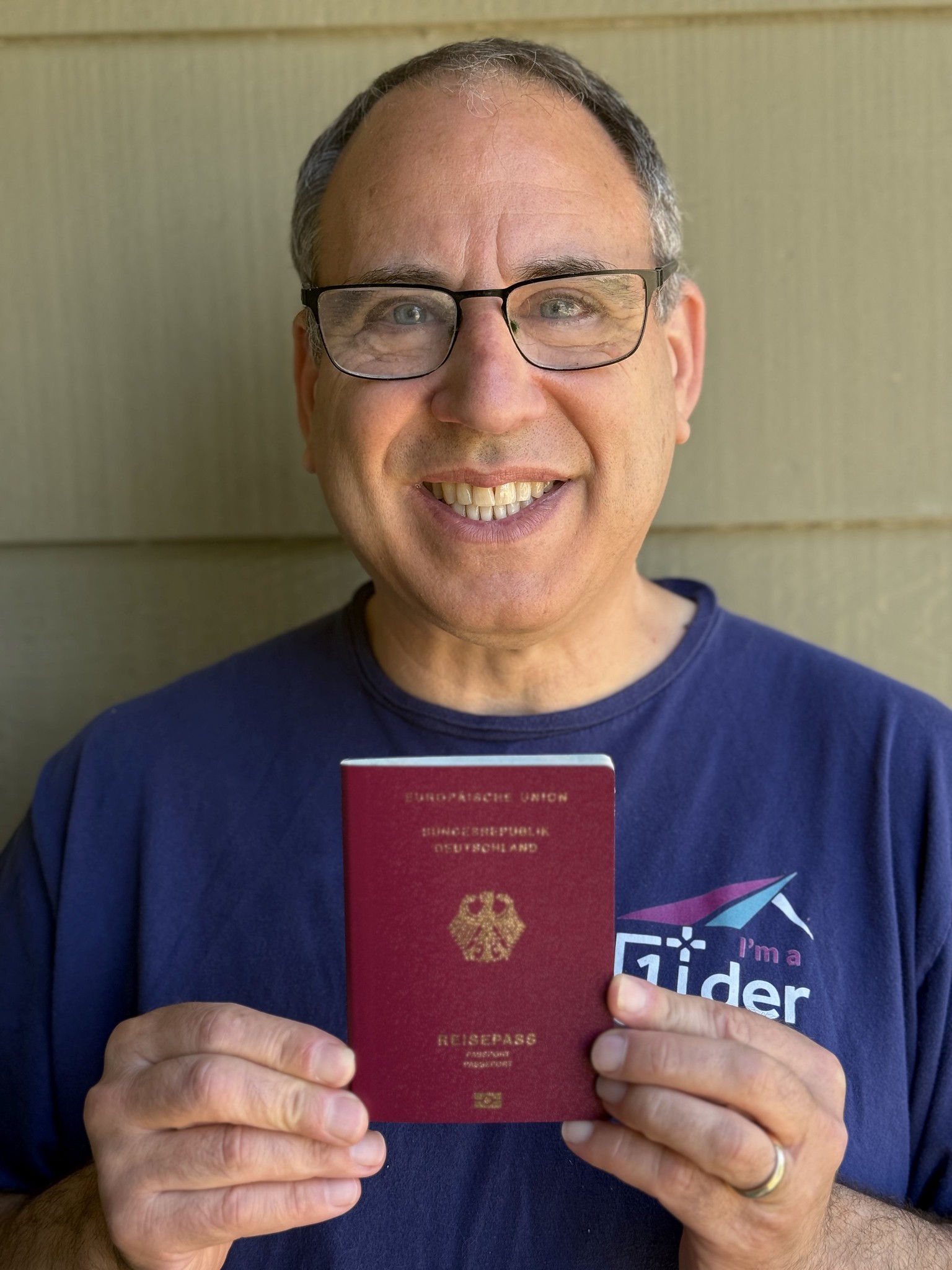 As my next post will explain, I was eligible to apply for German citizenship because my grandparents emigrated from Germany in 1937. That made German citizenship the obvious option to pursue.
I fully recognize the irony. My grandparents fled Nazi Germany because of the threats they faced there as Jews. Had they not left Germany when they did, the Nazis almost certainly would have murdered them. The U.S. was their Plan B–and what a great Plan B it turned out to be for them and their descendants, including me. Yet, now Germany/the E.U. is my Plan B if I no longer feel safe in the U.S. What a plot twist.
To be clear, my Plan A is to remain in the United States for the indefinite future. I don’t plan to move to Germany or anywhere else any time soon, if ever. But in light of my family’s history, I felt I had to create options for myself before I needed them. It’s like insurance. It gives me greater peace of mind to have a Plan B in place.
Eric — Fascinating story — thank you for sharing. My husband’s mother was born in Berlin in 1937, and her parents left with her at the end of that year. Such a similar story to yours. And my husband (and my son) recently got their German citizenship. We have no plans to move, but they do love being able to enter the EU with and EU passport, and having the possibility of living and working in the EU. Were your kids also able to get German citizenship?
–Viva
Yes! In total, 16 of my grandparents’ descendants, including me and my children, all got naturalized based on my application.
Although there’s little that you say that I disagree with, this somehow saddens me. But then I’ve been depressed about the state of our country for some time. I guess I don’t believe that in the next decade or so the US will become a place where Jews systematically face lethal danger. I don’t think our children can encompass leaving the US and we wouldn’t leave without them in any circumstances can imagine. Mitchell Z
[…] the second post in my four-part series about obtaining dual German citizenship. In my first post, I explained why. In this post, I’ll explain […]
[…] is part 3 of my 4-part series on obtaining German citizenship. My prior posts explained why and how I obtained German citizenship. This post provides short biographies of my paternal […]