

How I Obtained German Citizenship (Part 2 of 4)
* * *
The Nazi Germany regime denaturalized Jews in multiple ways. For example, in 1941, Nazi Germany terminated citizenship for Jews living outside Germany (the Eleventh Decree to the Law on the Citizenship of the Reich, Nov. 1941). To rectify these Nazi decisions, Germany enacted a “right of return” that lets descendants of affected Jews reclaim the German citizenship they would have ordinarily been entitled to. My paternal grandparents were covered by Article 116 (2), first sentence, of the Basic Law (GG) for the Federal Republic of Germany, making all of their descendants (including me) eligible for German citizenship.
Preliminary Steps
In summer 2024, I reached out to the German consulate in San Francisco about applying for citizenship. I was connected to a handler, Andrea, who patiently helped me understand and navigate the options. It was a pleasant shock to deal with a government official who was actually helpful and did more than the minimum. With Andrea’s guidance, I decided I didn’t need a lawyer. The main challenge would be gathering the supporting evidence, not interpreting the law.
I extended an invitation to my other relatives on my paternal grandparents’ side to piggyback on my application. In total, 16 family members applied.
Gathering the Evidence
My grandparents died over 20 years ago, so they (and everyone in their generation) were not around to provide the required evidence or answer any questions. We had to collect and recreate everything. I began gathering evidence in earnest in Fall 2024.
Some supporting evidence was fairly straightforward to obtain. For example, I submitted online requests for my grandparents’ birth certificates from their birth cities, Frankfurt and Crailsheim. Because the records were more than 100 years old, they had become historical documents not subject to privacy restrictions. I did need help translating them because Google Translate couldn’t handle old-style German cursive. A Fall 2024 German exchange student graciously recruited her grandmother to translate the birth certificates.
Other supporting evidence was extremely difficult to find. In particular, no one knew where my grandparents got married so that we could obtain a copy of their marriage license. Eventually, my brother-in-law figured out they got married in a Kentucky courthouse. I’ll discuss this unexpected wedding venue in my fourth blog post.
After everyone gathered their evidence, we sent the package to the German consulate in July 2025. The package had some missing pieces, such as some people’s dates of residence. The examiner didn’t flag those holes. If you’re going through this process, don’t let the perfect be the enemy of the good.
The Application Gets Bounced
In September 2025, the German examiner bounced our applications. We were missing: (1) proof that my grandparents were German citizens, and (2) certified copies of my grandparents’ U.S. Certificates of Naturalization.
The July 2025 package had evidence that I thought indicated German citizenship, including their birth certificates. However, German citizenship (like most countries) follows bloodlines, not place of birth. As for the Certificates of Naturalization, the US CIS doesn’t provide certified copies of Certificates of Naturalization, so I had submitted the photocopies they sent. I needed more guidance from the SF German consulate, which I got in December 2025.
Validating my grandparents’ German citizenship was as simple as getting copies of their family registries. We don’t have such documents in the US, but German cities catalogued an entire family in a single record that included the head of household’s citizenship. I requested my grandfather’s family registry from Frankfurt, which took 4 months. I also requested my grandmother’s family registry from Crailsheim. They emailed that overnight LOL.
Getting the U.S. Certificates of Naturalization was harder. No one in the family could find the originals in the family archives. That would have instantly solved the problem. The US CIS said repeatedly on their website that they don’t provide certified copies (I don’t know why they have this policy), and I had already submitted uncertified copies from the US CIS.
At the time of my grandparents’ naturalization, one original Certificate of Naturalization went to the federal government (now the US CIS), and another original was stored at the local courthouse. If I could find the local courthouse originals, perhaps I could get certified copies from them.
My grandparents got their Certificates of Naturalization in Parowan, Utah, a small mining town where my grandfather was the town doctor and my grandmother was the town nurse. I contacted multiple institutions in Utah to find the originals, including the Parowan City Clerk, the local judicial district, the Utah State Archives, and the National Archives in Denver. No one had it or could tell me who had it. The current location of those records would be an interesting mystery if it weren’t so frustrating. I never did find those originals.
Meanwhile, my brother-in-law spotted language on the US CIS website indicating that the German consulate had agreed to accept non-certified copies from US CIS (so long as the uncertified copies were sent with the US CIS envelope). I had already submitted the uncertified copies with the envelope in July 2025, but when I went back in December 2025, the office couldn’t find it. I ordered another uncertified copy of each certificate and didn’t open the envelope. I also took a screenshot of the US CIS website’s disclosure.
The Applications Get Approved
In April 2026, I mailed copies of the Frankfurt and Crailsheim family registries, the screenshot, and the envelope with the uncertified copies of the U.S. Certificates of Naturalization to the German examiner. A few weeks later, SUCCESS!!! All 16 of us received emails notifying us that our naturalization applications were approved and instructing us how to proceed.
Our consulate contact Andrea had warned us that naturalization applications can take years to review. However, she advised me that my aunt, who is over 80, would get her application fast-tracked due to her age. Indeed, we applied in July 2025 and were approved less than a year later; and the delay from September to April was due to my uncertainty how to proceed. In theory, the process could have gone faster if I had turned around the evidence resubmission faster. I don’t think we’d have the same quick approval cycle if my aunt had not been part of the package.
Reflections on the Experience
Overall, the process seemed intimidating but really wasn’t that complex, especially with Andrea’s help. Still, I found it stressful and traumatic.
It was stressful because 15 other family members were depending on me to help them with their Plan B. I felt an enormous weight of responsibility to complete the process for them.
It was traumatic because it forced me to relive, step-by-step, my grandparents’ experience. I visualized the challenges they faced and the sacrifices they made, all to give themselves and their descendants a better life. I felt lucky that I never had to navigate such traumatic experiences like they did. I felt bad for them that they faced so many challenges. I confronted the tragedies of my other family members who did not or could not make the same choices my grandparents made and, as a result, died in the Holocaust. I felt guilty that I never fully appreciated my grandparents’ efforts or even asked them much about their history (to be fair, they didn’t often talk about the old days and didn’t get very detailed when they did). I cried repeatedly during the process as I processed some of the generational trauma.
The Citizenship Ceremony
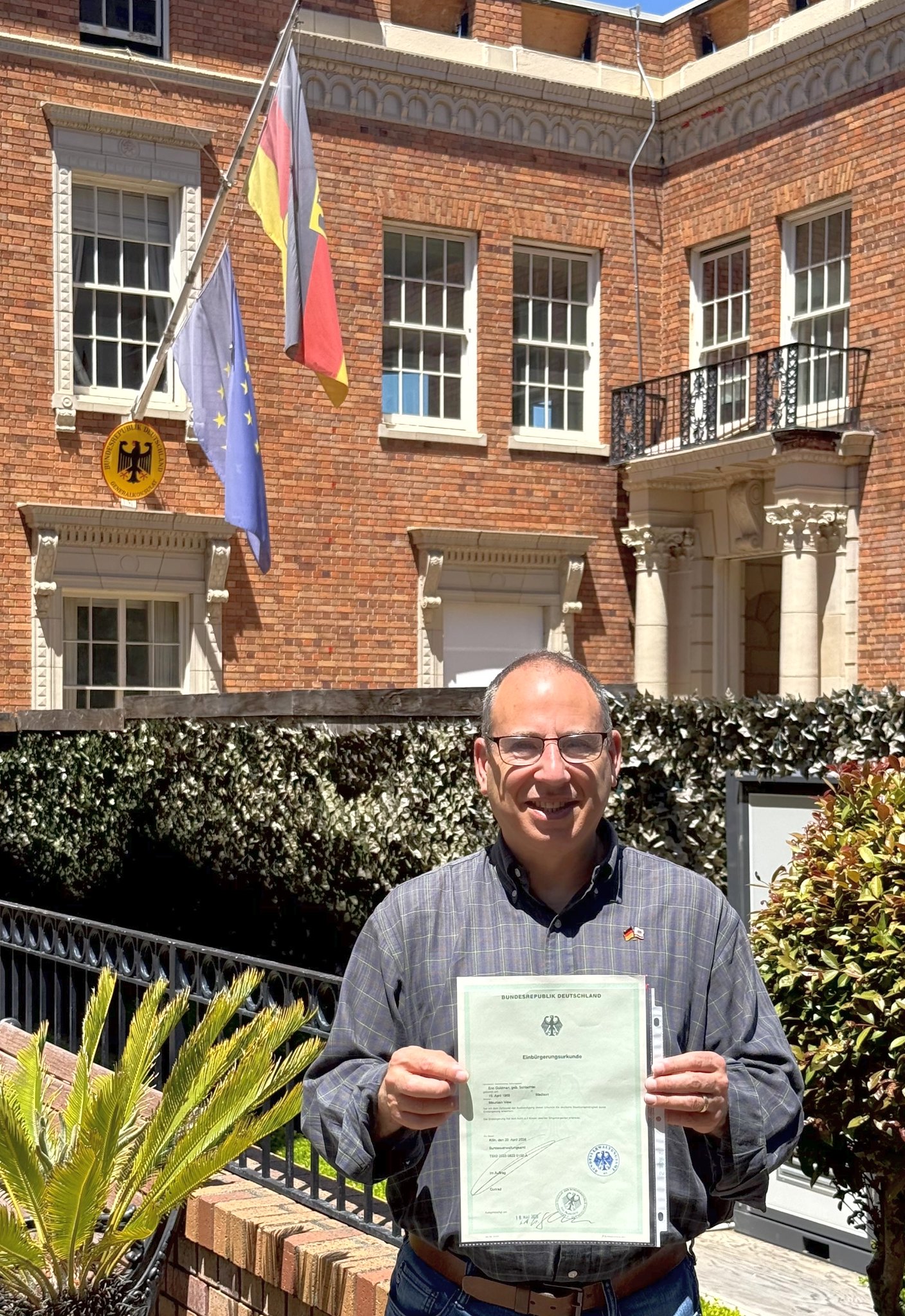
The consulate office allowed me to submit my passport application in the same visit. My E.U. passport arrived about a month later in mid-June. When my kids went to pick up their naturalization certificates, they were not given the opportunity to submit their passport applications, and passport application appointments at the SF consulate have a 3-4 month waitlist. So I got lucky with the timing of my passport application submission.
[…] post explains why I obtained German citizenship. Subsequent posts will explain how I did so; provide biographies of my German grandparents; and highlight some historical surprises I learned […]
Eric,
Congratulations on the restoration of your German Citizenship. You mentioned that your grandmother was born in Frankfurt.
The city of Frankfurt runs a “visit” program for the descendants of Frankfurters who fled the Nazis. I highly recommend it. If interested, email me and I will send you the details.