

Some Discoveries From My Genealogy Research (Part 4 of 4)
The Kentucky Marriage and “Baby Girl Schlachter”
My research quickly revealed a death certificate for “Baby Girl Schlachter,” who was born prematurely at 6 months on August 28, 1939 in Salt Lake City and died within twelve hours. My grandparents didn’t have time to give her a name.
I was shocked to learn that I had a great aunt who wasn’t listed on the family tree. I don’t recall my grandparents ever mentioning her (it’s possible I’m forgetting or didn’t understand some discussions).
Baby Girl Schlachter got me thinking about some counterfactuals. If Baby Girl Schlachter hadn’t died, would my grandparents have made different family plans or life decisions? Would I even exist in that counterfactual?
Baby Girl Schlachter also got me thinking about my grandparents’ wedding. My grandparents married in a Kentucky county courthouse on May 30, 1939. They were living in Ohio (in the Cincinnati area) at the time. Why would they travel an hour or more across state lines to get married? Why hold the wedding in a county courthouse? I can’t imagine any family members attended (the witnesses were court staff), and I doubt the wedding followed many Jewish customs. None of this made sense, unless…
Baby Girl Schlachter’s conception date appears to be late February/early March, and my grandparents got married in May. One possible explanation for the May wedding is that my grandparents hastily scheduled it before my grandmother started showing. This might also explain the Kentucky wedding venue, i.e., perhaps Kentucky had more relaxed rules for quick marriage licenses.
This theory raised more questions for me. Max and Rosel had been coordinating their moves for at least two years by the time of Baby Girl Schlachter’s birth/death, including the relocation from Germany to the U.S. After their long courtship and joint planning, why hadn’t they already married? Were they waiting for better economic prospects or more stability in their lives before they got married? Resolution of their immigration status? Something else? So many unanswered questions.
My Grandmother Was an Orphan
When I reviewed the family tree, I noticed that Rosel’s parents died when she was 5 and 9 (and her younger sister Heddy was only 6 when she was fully orphaned). This raises an obvious question: who took care of Rosel and Heddy after their parents’ deaths? What was the financial arrangement? Where did Rosel get the money to move from Crailsheim to Frankfurt and train as a nurse? Being orphaned at such a young age must have had a tremendous impact on her childhood, her development, and her perspectives on life.
“Deportient”
Reviewing the family tree, I saw that three of Rosel’s six other siblings who survived to adulthood—in other words, three of my great aunts and uncles—were murdered in the Holocaust, plus the child of one of those siblings. (My great-grandparents had 12 children in total. Five siblings died as children). According to the family tree, two of Rosel’s siblings died in a Riga camp in 1941, and another sibling and her child died in Auschwitz in 1943.
Next to the three siblings murdered in the Holocaust, the Crailsheim family registry has a simple notation: “deportient” (see the red ovals below).
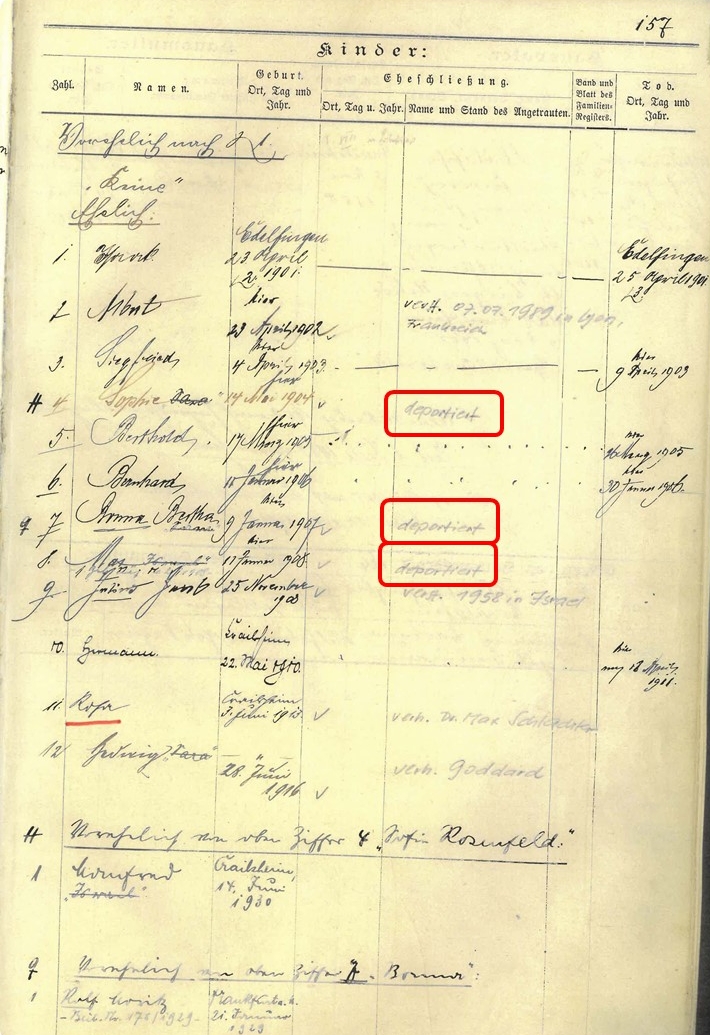
This is how the Nazi Germany government accounted for its Holocaust murders in the family records. The government stripped Jews of their citizenship and then “deported” these newly non-citizens out of the country to Nazi murder camps. The laconic statement “deportient” masks an enormous amount of government abuse, human trauma, and legal fictions. It makes the activity seem almost tidy and legally proper. It normalizes atrocities.
I suffer generational trauma when the Trump government and its associates seek to denaturalize U.S. citizens as political punishment or a racist flex, such as their current attacks on Rep. Ilhan Omar. “Denaturalization” means U.S. citizens would be stripped of their citizenship—just like Nazi Germany stripped my great aunts and uncles of their German citizenship. Without U.S. citizenship, the denaturalized individuals become newly vulnerable to government abuse, such as being forced to leave their homes, family, jobs, and social networks. Denaturalization creates an enormous amount of suffering and trauma, and anyone treating denaturalizations as a weaponizable tool appears to be embracing the Nazi playbook.