
What Should a 0L Incoming Law Student Do With Their Pre-1L Summer To Prepare for Law School?
I received an email from an incoming law student who has put down a deposit on a law school and is now wondering how they might productively spend their summer preparing for law school.
The traditional answer is that, if the students can afford it, they should take time off. Vacation and R&R time becomes scarcer once a student enters law school, plus students would benefit from entering 1L rested and ready for the rigors of 1L year. I agree with that advice. 😎
And yet, the 1L year has structurally changed due to the acceleration of Biglaw 2L summer hiring into the 1L year–and sometimes the first semester. This development is wholly unwelcome and disadvantages many students (and many firms). Nevertheless, it might suggest that strategies for 0L students should evolve.
[Note: many students aren’t interested in Biglaw, and many students who would accept a Biglaw position won’t be competitive for the positions. Still, this advice applies to all students, regardless of whether Biglaw is their destination.]
[Note: overall, this post suggests a lot of potential additional work for 0Ls. This is consistent with the general trend that Gen Z must work harder, and complete more tasks earlier in their career, than Boomers and GenXers had to do just so Gen Z can achieve similar outcomes. I’m sorry that the access bars keep rising on each successive generation.]
Accelerate Professional Identity Formation
Our Tech Edge (TEJD) program was developed to help students get an early start on their professional identity formation. See this TEJD backgrounder. We hold a TEJD orientation–crucially, before the law school orientation–that includes presentations from over a dozen lawyers and professionals explaining their jobs. This gives students a massive data download about possible career options they can explore. Furthermore, we assign each student two practitioner mentors who provide further insights into the profession and open up their networks for further investigatory meetings.
And yet, if a student came into that program with a clearer sense of their professional identity, they would get even more out of those resources. And if they are not in TEJD or a similar program, they may not have other simple paths to forming their professional identity once law school starts.
Meanwhile, the clock starts ticking fast on 1L students to have answers about their professional direction. Biglaw firms may open their hiring portals by December of 1L year or even earlier. That leaves 1L students a precious few months to sort through their professional identity formation before potentially making significant choices about their future–all while suffering through the other challenges of the first semester.
If a student has the privilege[FN] to begin working on their professional identity formation before 1L year starts, they can lay a better foundation for the short window they’ll have. This will help students begin to formulate their 30-second sales pitch of who they are and what they are looking for, helping them stand out in interviews, and to improve their process of sorting firms to find the ones with desired practice areas.
[FN: You’ll note that I use the term “privilege” because many students will not be able to follow this advice. It’s one of the ways that the accelerated law firm hiring schedule encodes privilege, exacerbating a rich-get-richer dynamic that pervades law school].
As a result, 0L students would benefit from doing their job/market research (what used to be called “networking”) during their summer. 0L students can find interviewees through their existing LinkedIn network or by seeking out alums of the school they will be enrolling in. Lawyers are surprisingly willing to help out students with requests like this (with a special shoutout to Santa Clara Law alums, who are incredibly generous and kind to students). During the meeting, students should ask the following questions:
* what does your job entail?
* what do you like about your job?
* what don’t you like about your job?
* how does someone get a job like yours?
* what information resources do you use to stay current? Students can start reading those resources to build the vocabulary and understand the topics of the practice areas they hope to pursue.
In the Tech Edge program, we use the Designing Your Life system to help students visualize their interests and gather the supporting market data.
Invest in Learning How They Will Be Tested as a 1L Student
Putting aside the accelerated expectations for professional identity formation, first semester students already have a boatload of work to do. They need to simultaneously (1) learn the law, (2) learn how to learn the law, and (3) learn how to be tested on #1 and #2. Students focus a lot on #1, sometimes on #2, and ignore #3. Yet, #3 may be critical to their overall journey, so it deserves more attention than it often gets.
During the 0L summer, students can try to understand how law school exams are structured and what they can do during their first semester to optimize their preparation. Often, the hardest adjustment for students is to get past “binary” thinking. In law school, often there is not a single right answer to a particular question. Instead, there may be potentially multiple correct answers, each with their own pros and cons. An answer that navigates the options and transparently evaluates each may be a much higher scoring answer than the answer that summarily provides a single “correct” answer. The old classic book on this topic is “Getting to Maybe,” but there are many other helpful resources on this front. Students can front-load this infrastructure building as 0L summer prep.
Certifications/Licenses
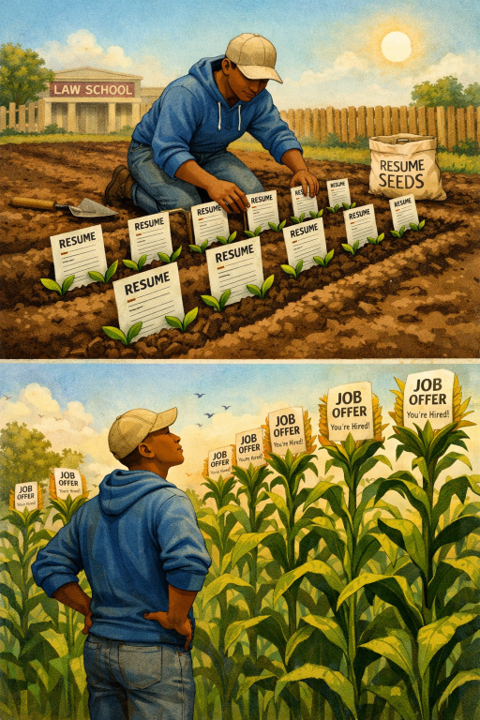
Produced via ChatGPT March 2026
If a student’s resume is going to be scrutinized immediately after the first semester, there is an even greater premium to adding good items to the resume as early as possible.
One straightforward approach is to get additional licenses or certifications that employers might value. If a student is patent bar-eligible, having the patent bar on the resume during 1L job searching would be a valuable asset. [Note: a patent bar license is required only for patent prosecution before the USPTO. There are many other jobs in the IP and tech field that don’t require the patent bar license or a technical background.]
We are also seeing great student demand for certifications from the IAPP, such as the CIPP and AIGP. From 2020-2025, Santa Clara Law had a total of about 250 law students pursue one or more IAPP certifications. Santa Clara Law students have a discounted path to obtain the certifications, but we would generally advise students not to study for a certification during a 1L semester. As a result, for students who can afford it, they might consider getting the certification during 0L summer so that it’s on the resume when they start law school. Another possibility is to find an existing student who can lend the prep materials for summer study, followed by signing up to take the test once the student is eligible for the discounted option.
Employers are also keenly interested in students’ skills at using AI to aid their legal efforts, so any certifications of AI abilities would also be a welcome addition to any resume.
Students might get other ideas of potential licenses and certifications to consider by asking about it in their market research meetings.
Conclusion
I reiterate that many students won’t have the time and money to pursue these strategies before law school. That’s OK, there are many paths to success, and none of the topics addressed in this post are critical-path items that must be completed before law school to achieve a student’s goals. Still, unmistakably, there is an increasing premium being rewarded to incoming 0L students who have completed some of the tasks that we used to expect students to do while in law school. I’m sorry that’s the case, but if you have the privilege to move the work before law school, you may reap some rewards for doing so.
I welcome your thoughts about my suggestions and any I missed. I just ask that your guidance reflect the job market and professional identity formation developments of the last couple of years, not experiences from many years or decades ago because those perspectives may no longer reflect the realities facing current 0Ls.
__
UPDATE: Comments received online:
- “I always tell entering 1Ls: If you’re not already a good typist, and typing is the way you will prepare written work and take notes, get good at it over the summer.”
- “learn how to auto pilot essential tasks. This means building meal prepping muscle memory, reading 50 pages a day, getting really really good at responding to emails, figuring out your favorite way to overcome frustration (excercise, scream, rant, eat), etc.”
- “Read for pleasure, as it may be awhile before you can do so again.”
- “Read 1L and watch The Paper Chase. Outdated in some ways, but still very relevant in others.” [I’ll add: these describe the Boomer experience, which has evolved a lot for GenZ.]
- “Find bar review course outlines for your first semester classes and read them. It’s invaluable to have a big picture scaffold to understand what you are learning, as you learn it. (For example, my torts Prof never explained that a tort has elements. Would have been good to understand that going in.)”
All this is wise advice as are the 2 comments. I have practiced IP law for 50 years. I still practice. It breaks my heart to see the erosion of the rule of law these students are seeing at an accelerated rate.
I ask summer associates how they think about being a lawyer, going forward. Most have already seen dramatic changes since they started law school. Many reply that their chosen field, patent litigation, is less subject to the changes in the rule of law, the Constitution. (Many already have doctorates in the sciences). Compared with administrative/agency law, and many other fields, yes. But patent law is about business and business and politics are inextricably bound.
I wonder how the 0L’s think about this.